Strategic Research Theme: AI, Society and Social Dynamics

AI is rapidly reaching every aspect of the world, transforming everything from daily work habits and social interactions to the environment and our health. A new SRT is gearing up to track, predict and guide its impact on humans and society.
The huge potential of AI to bring about positive change in the world is becoming apparent in areas from medicine and healthcare to education and science. In many fields, it is already clear that work processes are becoming faster, output quantity is increasing and repetitive tasks are becoming a thing of the past. Along with the potential for good, however, are a ream of challenges and the outcomes of these are still largely unknown. Less visibly, for example, AI is sparking changes to how our thought processes work, how we handle emotions, how we interact with each other and it may already be changing our brains in ways we have not yet fully understood.
Unresolved Potential
Many of the key questions remain open, but they concern not only risks, but also how we can best realise the benefits of AI. Will faster work processes translate into new forms of productivity, or instead promote higher unemployment and inequality? Will vastly expanded access to information empower students, or also create new avenues for manipulation? How will frequent interactions with AI reshape our relationships and our brains? Can these tools be designed to support rather than undermine mental health and social connection? And, crucially, how can we ensure that decisions about developing, deploying and governing this powerful technology account for the ‘human interface’ in terms of human behaviour, emotions and human needs?
These are some of the many questions that Professor Benjamin Becker of the Department of Psychology and his colleagues are planning to examine in their Strategic Research Theme (SRT) “AI, Society and Social Dynamics,” one of four SRTs that the Faculty will foster. The team’s aim is to develop and establish a comprehensive initiative for capturing, predicting and guiding the multifaceted transformations that AI and new technology bring to individuals, organisations, societies and global dynamics. Professor Becker describes this as: “While the world is still asking ‘what can AI do?’, our focus is on the more consequential questions of the human interface – in particular, how AI will affect humans, mental health, societies and planetary sustainability. It is a cross‑cutting challenge that demands rapid, coordinated action.”
An Expanding Team
The team is co-led by Professor Becker, Professor Duoduo Xu of the Department of Sociology and Professor Yuyu Zhou of the Department of Geography.
“AI’s rapid growth is driving up energy consumption and worsening global environmental inequalities, making the climate crisis far more severe for the most vulnerable communities,” says Professor Zhou. “This timely topic allows us to combine our perspectives and to anticipate and actively guide changes that are already happening, rather than responding after the fact.”
Professor Xu adds: “In the book The Race between Education and Technology, the authors argue that technological change, education, and inequality are locked in a kind of race. When technology advances faster than our education systems can adapt, society experiences a period of strain, often marked by rising inequality. That’s exactly the risk we face with AI today. To keep up, our education system must evolve much more quickly—focusing on equipping students with the skills that are actually in demand, not just today, but in a world where technological change is constant.”
“My research mainly focuses on the individual level – how and why individuals interact with AI and how this will impact human thoughts, emotions, social interactions and the underlying brain circuits – and my two colleagues look then at how this basically spirals along into the society ranging from social systems to climate change,” explains Professor Becker.
As news of the SRT spread, colleagues from many other fields quickly expressed interest in participating, recalls Professor Becker: “Suddenly, we had a topic where all disciplines brought fresh perspectives and up‑to‑date findings, from data on how AI is reshaping labour markets to evidence on its environmental footprint as large data centres transform electricity infrastructures.”
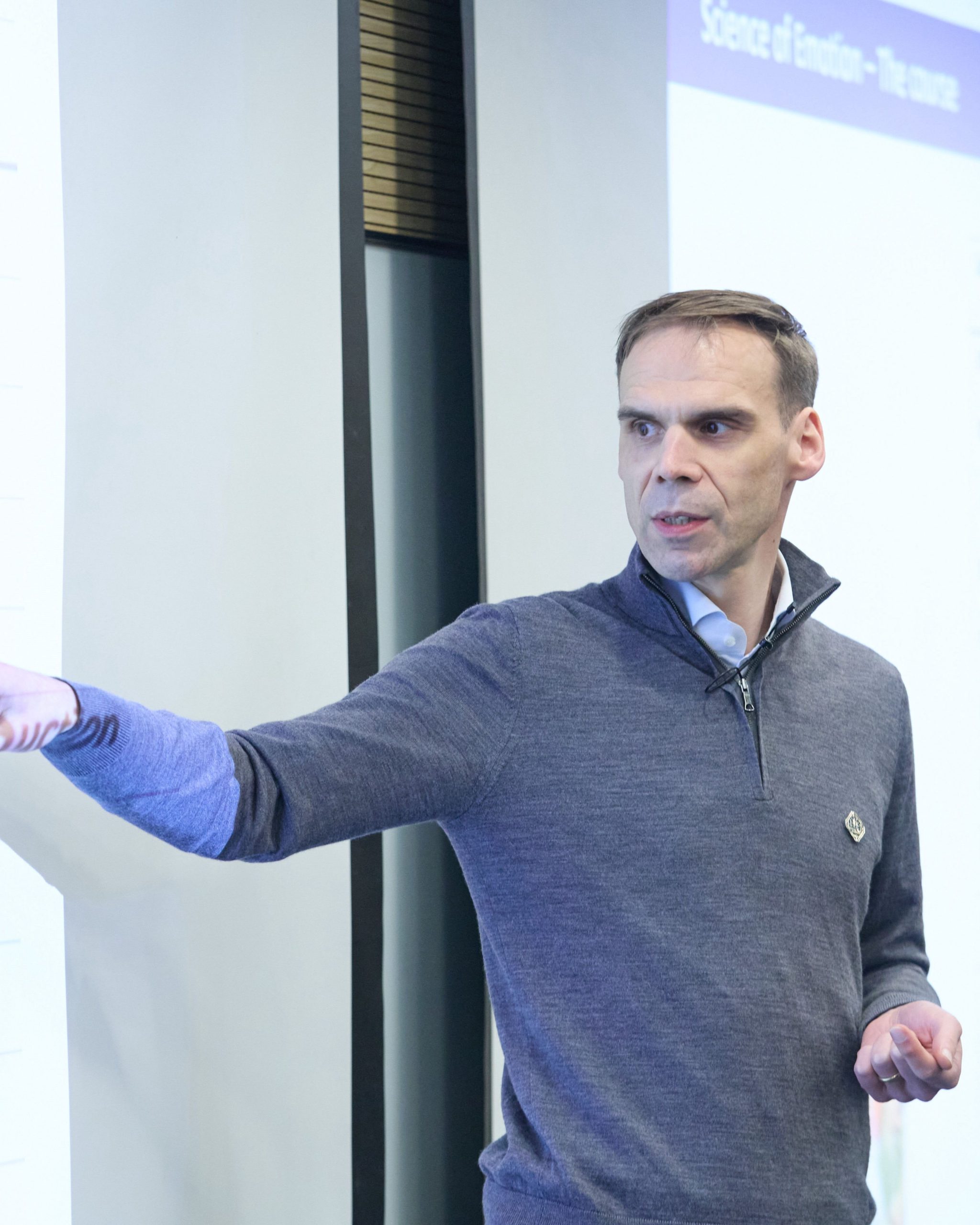


The team is co-led by Professor Benjamin Becker (Psychology), Professor Duoduo Xu (Sociology) and Professor Yuyu Zhou (Geography).
Triple Advantage
As evidenced by the broad interest in AI among different Faculty members, the University’s rich collection of expertise across specialisms gives it a potent advantage in its mission of researching the impact of AI. A second advantage is the University’s long tradition of working with companies that are already using AI, which has helped the team connect with those active in the sector with a view to possibly working with them. A third and key advantage is the Faculty’s focus on the human aspects of AI.
“While AI has become social infrastructure, very few centres focus on the human interface,” says Professor Becker. “No matter how advanced AI becomes, there is always a human on one side of the interaction. Our commitment to understanding the human side and guiding human-centred AI makes our SRT distinctive and future-oriented”.
Changing Our Minds
In Asia, this line of research is particularly pertinent. Studies conducted by Professor Becker have found higher levels of trust in AI compared to Europe, for example. This is particularly true among young people, and they are also increasingly using AI as a companion rather than simply a work tool.
Initial results from his research show, for example, that frequent use of AI may reshape the human brain and behaviour and that the same class of AI tools exerts distinct behavioural and brain effects depending on how and why humans use it.
A Race to Keep Up
The challenge for the team now is to keep up with AI as it continues its rapid growth and constantly expands to cover new ground.
“The impact on social behaviour, mental health, the job market or building of large data centres is not a distant future but all of these changes are already ongoing,” Professor Becker says. “We are trying to predict and guide, but many of these changes are already happening and we need to act quickly.”
Contributing writer: Liana Cafolla