AI Era: Risks and Opportunities in AI Venting; Moral Guidelines Can Be Altered in 5 Minutes. HKU Psychology Professor: Must Think on How to Use It Wisely to Avoid Social Disaster
(Translated by AI, please refer to the original article: Here)
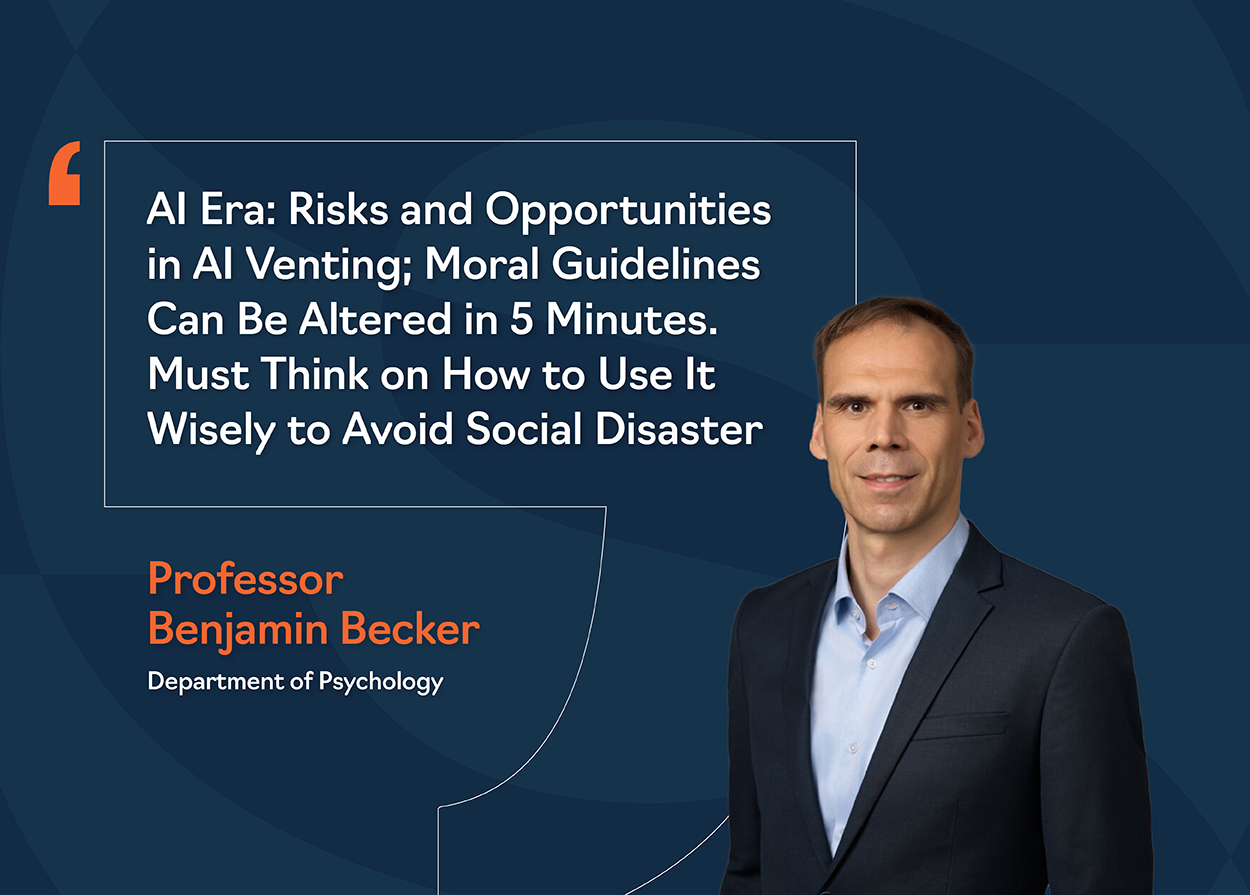
[Ming Pao News] As artificial intelligence chatbots (AI chatbots) have evolved, beyond handling information-related queries, an increasing number of people are turning to AI to confide their inner thoughts—seeking advice on romantic breakups, workplace confusion, and dealing with low moods. Renowned neuroscientist and University of Hong Kong (HKU) Department of Psychology Professor Benjamin Becker described this phenomenon as “fraught with both risks and opportunities.” He noted that while some specially designed AI chatbots offer positive support for mental health, his team’s research also found that interacting with AI for just five minutes can alter a person’s moral standards. He emphasizes that society needs to “take immediate action” to figure out how to use AI wisely so that it does not transform into a social disaster a decade from now.
Tech Giants Design with Profits First; AI Tends to Agree with Users
“The biggest crisis I see is that the AI chatbots currently used to provide social, mental health support, and advice are mostly provided by tech corporations,” Becker said in an exclusive interview with this newspaper. He pointed out that for businesses, the primary goal is to keep users “online” and generate profits by collecting user data. Consequently, these programs are typically designed to exhibit empathetic traits and tend to echo or agree with the user’s perspective. He noted that while many people find temporary relief after venting to AI under stress, some individuals with more severe depression grow increasingly dependent on AI, gradually reducing their daily interactions with real people, which could stunt the social development of adolescents.
However, Becker points out that AI as a tool for emotional communication can achieve great results in improving mental health. He cited examples of systems specifically designed by researchers to support mental health: users showed emotional improvement after interacting with them and did not subsequently become dependent on the AI. This offers a positive lifeline for many individuals suffering from depression and anxiety who cannot access psychotherapy or counseling due to time constraints or financial difficulties.
Urging Government, Professionals, and NGOs to Collaborate and Clarify Responsibilities
“The core question is: who should be responsible for regulation? We cannot leave this problem to corporations that only care about making a profit,” Becker stated. He believes that only governments possess the authority to compel companies to follow regulations, making state intervention a responsibility. However, because politicians do not understand mental health or the psychological developmental needs of adolescents, the government must collaborate with scientists, clinical professionals, and non-governmental organizations (NGOs) to consult professional advice.
He mentioned that there have been several lawsuits in the United States in recent years involving teenagers who died by suicide after interacting with AI chatbots. Therefore, he believes that when AI is utilized for emotional or mental health support, issues of rights and responsibilities require broad societal discussion and management: “Because the issue of accountability remains unresolved, it creates dangers while simultaneously causing us to miss opportunities—even if we have excellent AI mental health chatbots, we lack the corresponding legal framework to regulate them.” He believes patients should have the right to decide whether to disclose their dialogue history with AI to their therapists, allowing clinical professionals or psychologists to continuously follow up and monitor the patient’s condition.
Urging Caution from Social Media’s Impact; Outright Ban is Not a Long-Term Solution
Becker’s research team also discovered that a person’s moral standards change after venting to AI. He and his team published an article this April detailing how researchers fed instructions to an AI model, asking it to try to influence participants’ views on specific events during a 5-minute conversation: “For example, ‘Your boss promoted an unqualified relative, to what extent is this unethical?’ Most participants felt it was 80% unethical; but after a 5-minute conversation with AI, they felt the situation wasn’t as bad,” and participants maintained a similar view to the AI’s two weeks later. He also cited other research indicating that terrorists change their extremist thoughts after extended conversations with AI, describing AI as a knife that “can be used for cooking or for killing”—it can be used for benevolent purposes or to manipulate people’s perspectives.
Drawing lessons from the widespread adoption of social media (“It may have been good at the start, but now it has become a major disaster”) which has triggered numerous mental health issues—with some countries recently even legislating restrictions on minors using social media—Becker believes that legislating an outright ban is not a long-term solution regarding the rise of AI. He firmly believes AI can bring opportunities to mental health support, but society must take action to hold deep discussions regarding the intended uses of AI: “We must find the right path to make it create a positive impact, rather than letting it turn into another major catastrophe a decade from now.”