Scholars: Singapore Measures May Not Suit Hong Kong; Helping Foreign Workers Settle Could Relieve Population Ageing Faster
(Translated by AI, please refer to the original article: Here)
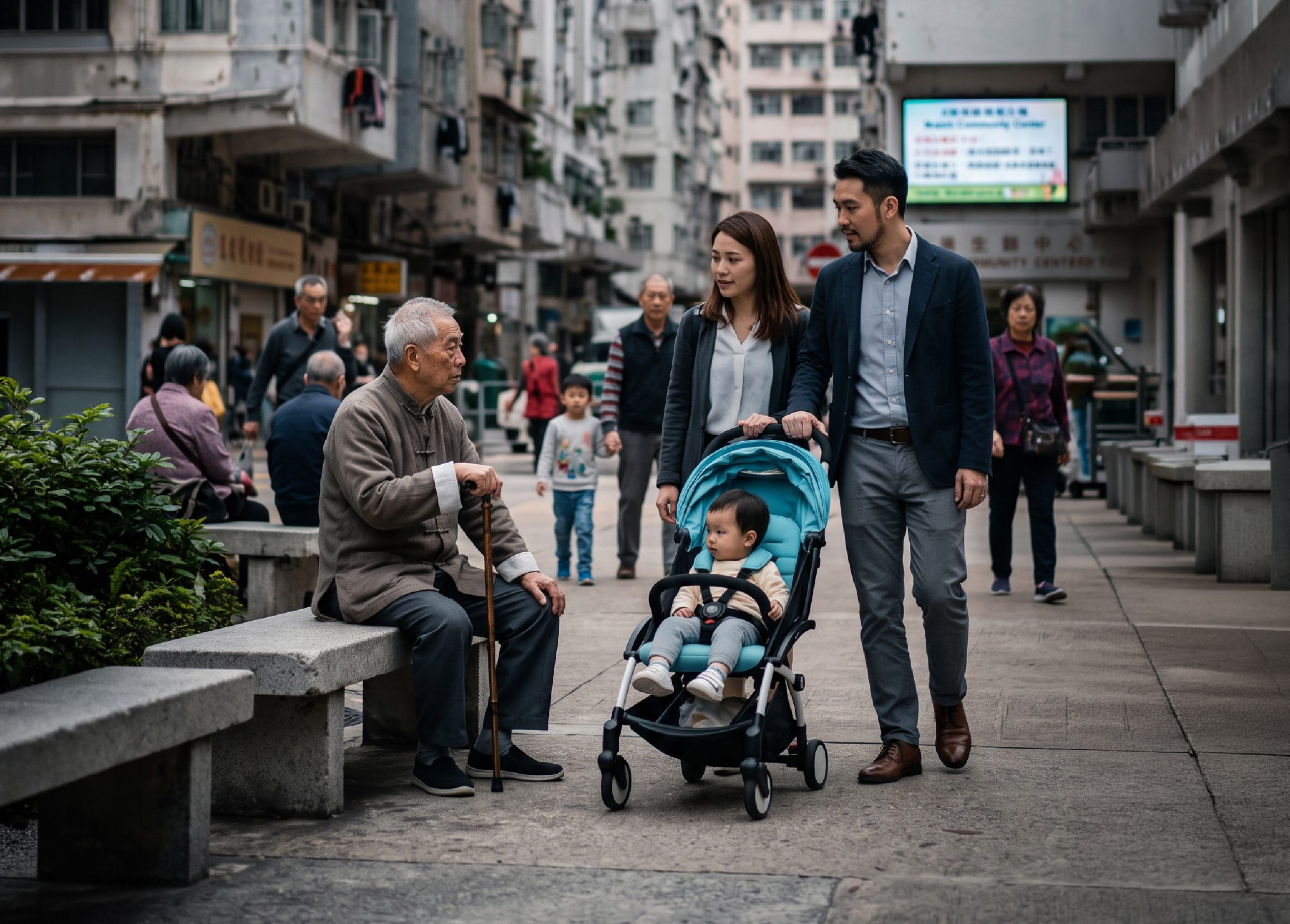
Data from the Census and Statistics Department shows that between mid-last year and mid-this year, only 29,700 babies were born in Hong Kong.
Since 2023, the Hong Kong government has offered a HK$20,000 newborn cash bonus alongside various measures to encourage childbirth. However, figures from the Census and Statistics Department reveal that between mid-last year and mid-this year, only 29,700 babies were born in the city—a sharp year-on-year drop of 18.5%.
Scholar Paul Yip Siu-fai noted that financial incentives have a limited impact on boosting birth rates and expressed reservations about Hong Kong following Singapore’s lead in increasing cash payouts and childcare leave. Meanwhile, another scholar, Chou Kee-lee, argued that encouraging childbirth cannot address population ageing in time, suggesting instead that importing foreign labor and encouraging Mainland students to study and settle in Hong Kong would be more effective.
Minimal Effect from HK$20,000 Newborn Bonus
In October 2023, the Hong Kong government launched a three-year HK$20,000 Newborn Baby Bonus scheme, which runs until October 24 this year. As of late May, the government had disbursed approximately HK$1.44 billion to 71,886 applicants. In addition, the government introduced extra tax allowances for newborns, priority schemes for public housing and subsidized home purchases, and enhanced childcare and assisted reproduction services. Despite these efforts, Census and Statistics Department figures show that only 29,700 babies were born from mid-last year to mid-this year, dropping 18.5% year-on-year and falling below the 30,000 mark.
Paul Yip Siu-fai, Chair Professor of Social Work and Social Administration at the University of Hong Kong, observed that the Singaporean government recognized early on that cash handouts alone could not raise fertility rates. Consequently, beyond significantly increasing cash incentives, Singapore enhanced supporting measures such as parental leave and promoted nationwide AI adoption to sustain productivity. In Hong Kong, the impact of the HK$20,000 newborn bonus has been minimal. “Those 29,000 pairs of parents would have had children even without the cash reward,” Yip noted, adding that he remains cautious about Hong Kong copying Singapore’s approach.
Yip believes that Hong Kong residents consider factors like education and future social prospects when deciding to have children, and he urged the government to improve the childcare and educational environment. He also pointed out that, unlike Singapore, the Hong Kong government can import population directly from Mainland China.
Proposal to Improve Educational Environment and Retain Talent
Chou Kee-lee, Chair Professor of Social Policy at The Education University of Hong Kong, pointed out that there is no effective universal solution to low fertility rates and population ageing, with financial incentives failing globally and childcare leave showing little impact. However, as an international city with top-ranked universities, Hong Kong can attract outstanding Mainland university students to pursue higher education here and assist them in staying to work after graduation, which could solve population challenges more efficiently.
“It takes 20 years for a newborn to reach working age, whereas in the next 10 to 20 years, one in three people in Hong Kong will already be elderly,” Chou said. As for the labor shortage, he added that importing foreign workers can help alleviate immediate pressures.
Legislative Council Member Lillian Lam Lam remarked that given the reduced social welfare budget, replicating Singapore’s measures is impractical. She suggested the government conduct a mid-term population strategy review to examine the reasons why people aged 25–34 and 35–45 choose not to have children, addressing the root causes to refine long-term population policies. In the short term, she advised retaining the newborn cash bonus while strengthening childcare and maternal and child health services.
Published in Sing Tao Headline on August 25, 2026.