HKU Researchers Reveal Hidden Climate Threat: PM2.5 Pollution Undermines Plant Water-Use Efficiency and Carbon Uptake

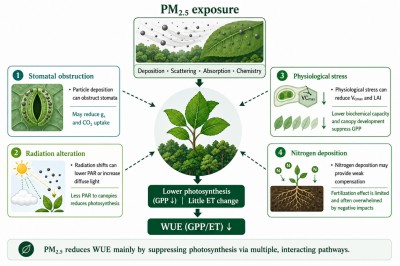
Researchers of the Faculty of Social Sciences at the University of Hong Kong (HKU) have discovered that fine particulate pollution (PM2.5) significantly impairs the ability of plants to efficiently use water and absorb carbon dioxide. The findings reveal that PM2.5 pollution weakens the vital carbon-water coupling of vegetation, highlighting that mitigating air pollution is not only a public health priority but also a critical climate action imperative.
While rising atmospheric CO2 and climate change have generally enhanced plant water-use efficiency (WUE) globally over the past decades, the specific influence of PM2.5 on this process has remained poorly understood.
Drawing on a comprehensive global database of tree-ring isotopes, eddy-covariance fluxes, and satellite-derived vegetation metrics, a research team led by Professor Yuyu Zhou from the Department of Geography, Faculty of Social Sciences at HKU, demonstrated that PM2.5 exerts a predominantly negative influence on WUE across various spatial scales. This pollution effectively weakens the CO2-induced WUE gains observed since the 2000s, with the magnitude of this effect varying geographically based on interactions among vegetation traits, pollution levels, and local climates.
The study reveals that this decline in WUE is primarily driven by the PM2.5-induced suppression of photosynthesis – the process by which plants gain carbon – rather than changes in evapotranspiration (water loss). PM2.5 pollution reduces photosynthetically active radiation and the plants’ carboxylation capacity, fundamentally hindering their ability to thrive and capture carbon.
Furthermore, the research exposes a critical flaw in current ecosystem models, which systematically misrepresent these effects. Because existing models omit aerosol processes and rely solely on vegetation responses to covarying climate drivers, they fail to reproduce the observed PM2.5-WUE relationship.
Key implications of the research:
– Inhibitive effects on plant water-use efficiency: PM2.5 pollution negatively impacts WUE across scales, weakening CO2-induced gains. The effect varies geographically, with forests and non-forests exhibiting distinct patterns.
– Photosynthetic suppression: The decline in WUE stems from reduced photosynthesis (carbon gain) due to lowered active radiation and carboxylation capacity, rather than changes in evapotranspiration (water loss).
– Limitations of current ecosystem models: Existing models fail to capture the PM2.5-WUE relationship because they omit aerosol inputs, proving that climate-driven responses alone cannot explain the observed effects.
– A call for integrated climate action: Reducing PM2.5 emissions is essential for enhancing terrestrial carbon uptake and resilience, especially in polluted regions. Future climate adaptation strategies and next-generation Earth system models must incorporate aerosol composition, size distribution, and deposition dynamics to prevent maladaptive outcomes.
The study was published in the leading journal Nature Climate Change.